
AI-Powered Decision Support for Modern Grid Operations
Electric utilities manage extensive networks of substations, transformers, feeders, distribution assets, mobile crews, contractors, warehouses, and maintenance resources. Maintaining visibility across these operational elements is essential for reliability, safety, regulatory compliance, and outage response performance.
GridEnergy AI applies artificial intelligence to information collected through RFID, BLE, GPS, LoRaWAN, cellular-connected devices, utility databases, workforce systems, and operational software. AI models help utility operators identify patterns, optimize resource utilization, improve workforce coordination, strengthen security controls, and increase visibility into critical infrastructure assets.
Unlike traditional reporting systems that primarily display historical information, AI-driven solutions continuously analyze operational activities, asset movements, workforce locations, inventory availability, maintenance progress, and access events to support faster and more informed decisions.
AI Functions Supporting Grid Asset & Workforce Systems
Modern utility operations require AI capabilities that focus on identification, location awareness, workforce coordination, operational visibility, and infrastructure management.
Core AI functions include:
Each capability contributes to improved visibility across utility operations while supporting reliability and workforce safety objectives.
AI for Field Workforce Tracking
Grid Crew Location Analytics
Utility crews frequently operate across large geographic service territories. During routine maintenance, emergency response activities, storm recovery operations, and infrastructure upgrades, supervisors require visibility into workforce deployment. AI-assisted location analytics helps utilities:
Machine learning algorithms evaluate workforce movement patterns, work assignments, travel times, and operational workloads to support more effective scheduling and dispatch management.
Substation Worker Safety Monitoring
Worker safety remains a primary concern in substations, switchyards, transmission facilities, and distribution environments. AI supports safety programs by helping organizations:
Location awareness combined with AI analysis helps improve operational oversight without increasing administrative burden on field personnel.
Field Technician Dispatch Optimization
Dispatch centers often manage hundreds of service requests, maintenance activities, inspections, and outage events. AI assists dispatch teams by analyzing:
The result is improved workforce utilization and faster response to operational requirements.
AI for Substation Access Control
Critical grid infrastructure requires strict control of personnel access while maintaining operational efficiency.
Automated Substation Access Verification
AI-enabled access management systems help utilities automatically verify access permissions based on:
Automated verification reduces manual administration while supporting security requirements.
Grid Facility Perimeter Security
Substations, switching stations, storage yards, and control facilities require continuous security oversight. AI supports perimeter security through:
Security teams gain improved visibility into facility access activity while maintaining audit readiness.
Restricted Zone Entry Analytics
Many utility sites contain areas requiring specialized authorization. AI systems help organizations:
These capabilities are particularly valuable for transmission infrastructure, high-voltage equipment areas, and critical operational facilities.
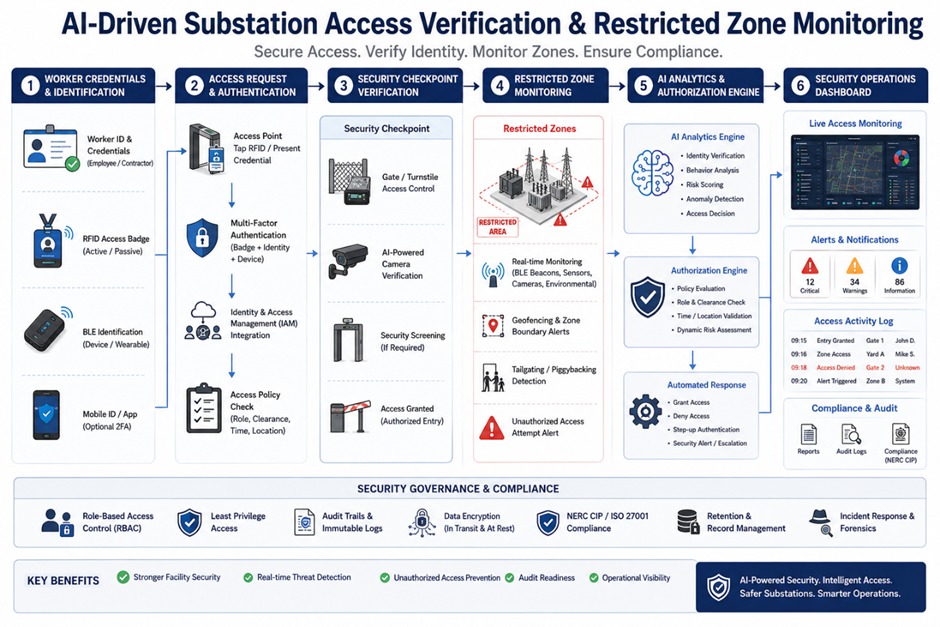
AI-Driven Utility Substation Access Control and Security Workflow Diagram for RFID, BLE, and Compliance Monitoring
This security workflow diagram shows how AI-powered access control integrates RFID badges, BLE identification devices, security checkpoints, and restricted zone monitoring to protect utility substations. It demonstrates automated authorization, real-time threat detection, compliance tracking, and centralized security dashboards that enhance facility security, workforce accountability, and regulatory compliance.
AI for Grid Asset Tracking
Utility infrastructure contains thousands of distributed assets that require accurate identification and location visibility.
Transformer & Feeder Asset Monitoring
Transformers and feeder assets represent critical components of grid reliability. AI-powered asset monitoring supports:
Organizations gain greater visibility into asset deployment and operational status.
Distribution Equipment Location Analytics
Distribution operations often involve mobile and fixed infrastructure spread across extensive territories. AI analyzes:
These insights improve planning and resource allocation.
Grid Infrastructure Asset Health Scoring
AI can evaluate historical records, maintenance activities, utilization trends, and operational events to generate asset health scores. Benefits include:
Health scoring helps utilities focus resources on infrastructure requiring attention.
AI for Inventory Optimization
Utility warehouses and service centers require accurate inventory management to support maintenance and emergency response.
Spare Parts Inventory Optimization
AI helps utilities improve inventory performance by analyzing:
Organizations can reduce shortages while avoiding unnecessary inventory accumulation.
Substation Stock Level Forecasting
Maintaining appropriate stock levels is essential for operational readiness. AI forecasting models support:
Warehouse Inventory Demand Prediction
Utility operations generate complex inventory demand patterns. Demand prediction capabilities help organizations:
AI for Grid Maintenance Progress Tracking
Maintenance programs and grid modernization initiatives involve significant operational coordination.
Outage Restoration Progress Analytics
During outage events, utility organizations require continuous visibility into restoration activities. AI supports restoration management by helping operators:
- Monitor work progress
- Track crew deployment
- Identify delays
- Prioritize activities
- Improve coordination
- Support executive reporting
Grid Upgrade Project Tracking
- Monitor milestone completion
- Validate field activities
- Measure productivity
- Improve resource utilization
- Support project governance
Progress visibility contributes to more predictable project execution.
AI for Grid Component Traceability
Traceability is increasingly important for regulatory compliance, asset management, and operational accountability.
Transformer Lifecycle Traceability
Utilities must maintain accurate records throughout transformer lifecycles. AI supports:
- Asset history management
- Maintenance documentation
- Location records
- Ownership tracking
- Replacement history
- Compliance reporting
Meter Compliance Traceability Records
Meter management programs require comprehensive documentation and audit support. AI-driven traceability solutions assist with:
- Compliance verification
- Inspection records
- Certification management
- Deployment documentation
- Regulatory reporting
AI Benefits Across Smart Grid Operations
Utilities implementing AI-enabled workforce and asset visibility solutions often seek improvements in:
The combination of AI and IoT technologies enables utility organizations to transform operational information into actionable decision support.
Applications Across Utility Environments
Transmission Networks
Applications include:
Distribution Operations
Utilities can improve:
Substations
Key applications include:
Why Utilities Choose GridEnergy AI
GridEnergy AI draws upon decades of IoT implementation experience across industrial sectors. Supported through Aperture Venture Studio and GAO, the company leverages knowledge gained from thousands of completed IoT projects and deployments. Technical leadership includes experienced engineers, utility specialists, and Ph.D. professionals who understand the operational realities of modern grid environments.
Extensive experience supporting utilities, industrial organizations, research institutions, government agencies, and Fortune 500 enterprises contributes to practical AI solutions designed for real-world operational requirements.
Next Steps
AI-powered workforce visibility, access governance, asset tracking, inventory optimization, maintenance analytics, and traceability capabilities help utilities improve reliability, safety, and operational performance across modern smart grid environments.
Explore GridEnergy AI solutions to learn how AI-driven decision support can strengthen utility operations, improve workforce coordination, and increase visibility across critical grid infrastructure.
Contact GridEnergy AI
Discuss your operational requirements with our technical specialists and explore how AIoT solutions can improve grid asset visibility, workforce safety, access control, inventory management, and utility infrastructure performance.
Contact Us