
Hardware Foundations for Grid Asset Visibility and Workforce Management
Smart grid operations require accurate identification, location awareness, workforce visibility, and asset accountability across geographically distributed utility infrastructure. AI and IoT solutions rely on specialized hardware technologies that connect physical assets, utility personnel, vehicles, inventory, and operational systems.
GridEnergy AI focuses on identification and location technologies that support utility operations across substations, transmission networks, distribution systems, renewable energy facilities, switching stations, maintenance depots, warehouses, and field service environments.
The hardware technologies discussed on this page are specifically selected to support:
These technologies provide the physical foundation for AI-driven utility operations.
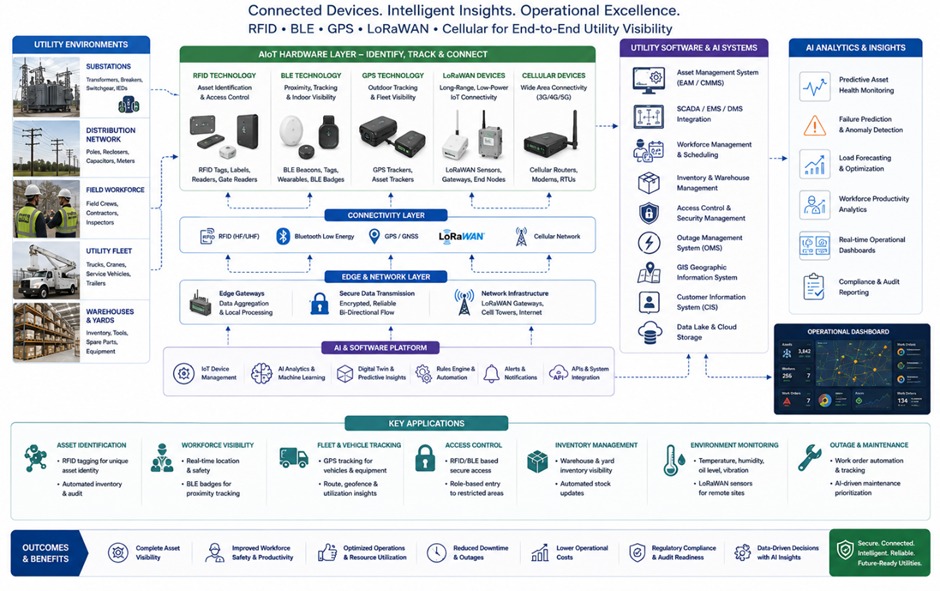
Utility AIoT Hardware System Diagram for RFID, BLE, GPS, LoRaWAN, Cellular Connectivity, and AI Analytics
This hardware system diagram shows how RFID, BLE, GPS, LoRaWAN, and cellular technologies connect utility field assets, workforce, vehicles, substations, and warehouses to AI-driven software devices. It highlights end-to-end asset identification, workforce tracking, inventory visibility, access control, and real-time operational analytics that improve utility efficiency, security, and decision-making.
Grid Identification Devices
Identification devices form the foundation of utility asset visibility systems. Every asset, worker, vehicle, and inventory item must be uniquely identifiable before operational visibility can be achieved.
RFID Asset Tags
RFID asset tags enable utilities to identify and manage infrastructure assets throughout their operational lifecycle. Common utility applications include:
RFID tags can be attached to utility equipment during manufacturing, installation, commissioning, or maintenance activities. Each tag contains a unique identifier that links physical assets to utility databases and software systems.
Benefits include: Rapid asset identification, reduced manual data entry, improved inventory accuracy, better maintenance documentation, enhanced compliance reporting, and improved asset accountability.
BLE Beacons for Crew Tracking
Bluetooth Low Energy technology provides location visibility for utility workforce management. BLE devices support:
BLE technology is particularly useful within substations, utility facilities, warehouses, and maintenance centers where GPS signals may be limited.
GPS Trackers for Fleet Vehicles
Utility organizations frequently operate extensive fleets of service vehicles, maintenance trucks, inspection units, and specialized equipment. GPS tracking devices provide:
Fleet visibility contributes directly to improved operational efficiency and outage response performance.
AI and Hardware Technology Systems
AI and RFID for Grid Systems
RFID remains one of the most widely adopted identification technologies within utility operations.
RFID-Based Substation Access
RFID credentials help utilities verify personnel identity before granting facility access across transmission substations, distribution substations, control centers, switching facilities, storage yards, and maintenance compounds. Systems support employee authorization, contractor verification, visitor management, access event documentation, security audits, and compliance reporting.
RFID Transformer Identification
Transformers represent critical power delivery assets. RFID identification supports asset registration, installation documentation, location tracking, maintenance history, lifecycle management, and compliance documentation without relying on manual records. This improves asset visibility, maintenance planning, and long-term infrastructure management across utility operations.
RFID Inventory Management
Warehouse and service center operations benefit from spare transformer tracking, replacement component management, inventory reconciliation, warehouse audits, materials accountability, and stock verification. This approach improves inventory accuracy, reduces material losses, supports faster retrieval, and strengthens warehouse operational efficiency.
AI and BLE for Grid Systems
Bluetooth Low Energy technology supports workforce visibility and location awareness within utility facilities.
BLE Worker Proximity Detection
Provides visibility into workforce activity around critical infrastructure, supporting workforce accountability, work assignment validation, team coordination, restricted area awareness, and operational visibility.
BLE Indoor Substation Positioning
Substations contain complex layouts. BLE positioning supports worker location awareness, maintenance coordination, resource deployment visibility, workforce safety programs, and activity documentation.
BLE Credential Verification
BLE identification devices help utilities verify worker identities, manage facility access, track workforce presence, support compliance documentation, and improve security oversight.
AI and LoRaWAN for Grid Systems
LoRaWAN technology provides long-range wireless communication capabilities suitable for utility environments.
LoRaWAN Asset Location Tracking
Supports asset location reporting, distribution equipment visibility, yard management, remote infrastructure tracking, and operational accountability.
LoRaWAN Field Crew Connectivity
Supports workforce visibility, remote crew coordination, utility operations support, and project tracking in remote environments.
LoRaWAN Infrastructure Coverage
Deployable across distribution territories, renewable energy facilities, utility yards, service centers, and maintenance facilities.
AI and GPS & Cellular for Grid Systems
GPS and cellular technologies provide broad-area connectivity for mobile utility operations.
GPS Fleet & Crew Tracking
GPS technologies support vehicle tracking, crew deployment monitoring, emergency response coordination, resource utilization reporting, and dispatch optimization across large service areas.
Cellular-Connected Asset Trackers
Connects mobile equipment visibility, remote asset tracking, fleet accountability, resource allocation management, and operational reporting beyond facility boundaries.
Utility Vehicle Visibility
Service vehicles play a critical role during maintenance and outage restoration activities. GPS and cellular technologies help organizations improve fleet accountability, and monitor operational coverage.
Supporting Hardware Infrastructure & Selection Considerations
Successful deployments often include supporting infrastructure that enables communication between identification devices and operational software.
RFID Readers
Capture identification information from tagged utility assets and inventory items across warehouses, service centers, maintenance operations, substations, and access control points.
BLE Gateways
Collect information from BLE devices operating within substations, maintenance facilities, utility warehouses, and control centers.
Communication Gateways
Facilitate information transfer between field technologies and operational software systems to support utility-wide visibility, multi-site operations, and data synchronization.
Hardware Selection Considerations
Technology selection depends on operational requirements, deployment environments, and visibility objectives. Utilities commonly evaluate coverage requirements, location accuracy needs, asset categories, workforce visibility goals, security requirements, infrastructure availability, compliance obligations, and integration requirements. Different technologies often complement each other within a single deployment.
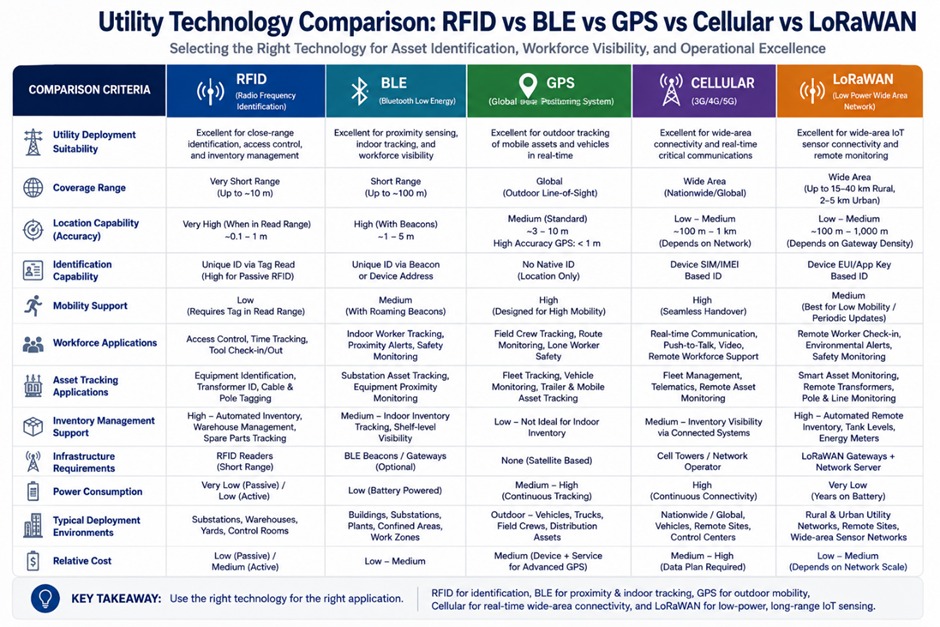
Utility Technology Comparison Table: RFID vs BLE vs GPS vs Cellular vs LoRaWAN for Smart Grid Applications
This comparison table evaluates RFID, BLE, GPS, Cellular, and LoRaWAN technologies across utility deployment suitability, coverage range, location and identification capabilities, mobility support, workforce applications, asset tracking, inventory management, and infrastructure requirements. It provides a practical reference for selecting the most appropriate technology to improve utility asset visibility, workforce management, operational efficiency, and smart grid performance.
U.S. and Canadian Standards & Regulations
Compliance, safety, and security governance frameworks shaping utility AIoT hardware deployments:
Workforce Visibility, Personnel Identification & Access Control
- NERC CIP-004 Personnel & Training
- NERC CIP-006 Physical Security of BES Cyber Systems
- NERC CIP-003 Security Management Controls
- NERC CIP-011 Information Protection
- NIST SP 800-53
- NIST Cybersecurity Framework (CSF)
- ISA/IEC 62443 Series
- FERC Reliability Standards
- CSA C22.3 Series
Asset Tracking, Inventory Management & Accountability
- IEEE 3007 Series, IEEE 493, IEEE 980, IEEE 1686
- IEEE C57 Series
- NERC CIP-002 BES Cyber System Categorization
- NERC CIP-013 Supply Chain Risk Management
- ISO 55001, ISO 55002, ISO 14224
- ANSI MH10 & GS1 Standards
- CSA Z463, CSA Z662, CSA SPE-1000
- FERC Asset Management Requirements
Traceability, Lifecycle Documentation & Compliance Records
- ISO 9001, ISO 27001, ISO 22301, ISO 31000
- NERC CIP-010 Configuration Change Management
- NERC CIP-007 System Security Management
- IEEE 1686, IEEE C57.12 Series, IEEE C57.91
- CSA Z246.1, CSA Z246.10, CSA Z662
- Records Management Standards for Utility Operations
Top Players in AI and IoT for Smart Grid & Energy Systems
Utility Software, Grid Operations & Digital Grid Leaders
- GE Vernova
- Siemens
- Schneider Electric
- Hitachi Energy
- ABB
Workforce Visibility, Access Control & Security
- HID Global
- LenelS2
- Honeywell
- Johnson Controls
- Genetec
RFID, BLE, RTLS & Identification Technologies
- Zebra Technologies
- Impinj
- Identiv
- Securitas Technology
- Litum
Case Studies: Smart Grid & Energy Systems AIoT Deployments
GridEnergy AI leverages decades of experience derived from thousands of IoT projects executed through GAO and related organizations serving utilities, critical infrastructure operators, government agencies, research institutions, and energy organizations. Our work in AI and IoT, AI and RFID, AI and BLE, and AIoT solutions focuses heavily on identification and location technologies that improve workforce visibility, access governance, asset accountability, inventory management, and operational efficiency across smart grid and energy systems.
AI and BLE Workforce Visibility and Substation Access Management System
A large utility operator managing transmission substations, switching facilities, and grid modernization projects faced challenges maintaining real-time awareness of personnel working across geographically dispersed sites. Multiple contractor teams, maintenance crews, and field technicians frequently moved between substations and operational facilities. Manual sign-in procedures created delays in accountability reporting. Security personnel required faster methods to verify authorized access to restricted electrical infrastructure. Operations managers needed improved visibility into workforce deployment during maintenance outages and grid reliability projects.
Additional challenges included: Limited visibility into contractor presence, delayed emergency accountability reporting, difficulty validating worksite attendance, inconsistent access documentation, and increased administrative effort during compliance audits.
GridEnergy AI designed and deployed an AI and BLE workforce visibility and access management solution using BLE technologies and identification-based AIoT methodologies. The deployment incorporated BLE badges assigned to utility personnel, BLE gateways installed at substations and operational facilities, AI-driven workforce location software, digital credential management software, access authorization management systems, and workforce accountability dashboards.
The solution utilized representative BLE gateways, BLE beacons, and BLE accessories commonly supplied through GAO RFID Inc. and GAO Tek Inc. projects supporting utility and critical infrastructure environments. BLE devices continuously supported workforce presence verification while AI software analyzed movement patterns, workforce utilization, site occupancy, and authorized access activities.
Utility supervisors gained visibility into: Workforce deployment status, technician location awareness, contractor accountability, restricted-area entry validation, and emergency response coordination.
The utility operator achieved measurable improvements in workforce accountability and operational visibility. Key outcomes included faster personnel accountability verification during maintenance activities, improved contractor visibility across substations, reduced manual access administration effort, more accurate compliance documentation, and improved workforce deployment reporting.
The most significant operational result was the reduction of personnel verification time during emergency response activities from manual processes requiring extensive coordination to near real-time workforce accountability reporting.
BLE-based workforce visibility significantly improves personnel accountability inside substations and utility facilities. Organizations should carefully evaluate facility layouts and gateway placement strategies because indoor positioning accuracy depends heavily on deployment planning and infrastructure coverage.
AI and RFID Transformer Tracking and Utility Inventory Management System
A utility organization responsible for transmission and distribution infrastructure managed thousands of transformers, circuit breakers, reclosers, and replacement components distributed across substations, service centers, warehouses, and maintenance facilities.
Asset accountability challenges included: Time-consuming transformer identification, manual inventory reconciliation processes, limited visibility into spare equipment locations, difficulty tracking equipment transfers, and delays locating replacement assets during outage restoration.
Utility personnel frequently relied on spreadsheets and manual verification methods to confirm asset status and inventory availability. Operational leaders sought an AI and RFID solution capable of improving visibility across critical utility assets while supporting maintenance planning, inventory management, and infrastructure accountability initiatives.
GridEnergy AI implemented an AI and RFID asset tracking and inventory visibility solution focused on utility identification and location technologies. The deployment utilized representative technologies commonly supported through GAO RFID Inc. and GAO Tek Inc. projects, including UHF RFID readers, UHF RFID tags, RFID antennas, RFID accessories, mobile RFID identification equipment, asset management software, and AI-enabled inventory analytics systems.
RFID tags were associated with transformers, switchgear, mobile utility equipment, and warehouse inventory items. AI and RFID software maintained records related to asset identification, equipment location, inventory availability, asset movement history, maintenance documentation, and lifecycle accountability.
Warehouse personnel used RFID readers to verify inventory locations and update equipment records. Field crews could rapidly identify utility assets during installation, maintenance, and replacement activities. AI analytics helped identify inventory utilization trends, equipment movement patterns, and operational bottlenecks affecting maintenance workflows.
The utility organization achieved substantial improvements in infrastructure visibility and inventory accountability. Operational benefits included faster transformer identification, improved inventory accuracy, better visibility into spare equipment availability, reduced time spent locating utility assets, improved maintenance documentation quality, and more efficient warehouse operations.
The most significant measurable result was a substantial reduction in asset search and identification time for critical utility equipment, enabling maintenance teams to locate and verify infrastructure assets significantly faster during planned maintenance and outage restoration activities.
RFID-based utility asset tracking delivers the greatest value when identification standards, tagging procedures, and inventory workflows are established before large-scale deployment. Organizations that invest early in data quality and asset registration processes typically achieve stronger long-term asset visibility outcomes.
AI and RFID Asset Traceability and Grid Infrastructure Lifecycle Management
A utility organization responsible for transmission substations, distribution infrastructure, and renewable energy interconnection projects required improved traceability across critical grid assets. The organization managed large numbers of transformers, switchgear assemblies, circuit breakers, protection equipment, and utility inventory distributed across multiple operational regions.
Existing documentation processes created challenges when tracking infrastructure throughout its lifecycle. Asset histories were maintained across multiple systems, making it difficult to quickly verify installation records, maintenance activities, relocation events, and replacement histories.
Operational challenges included: Limited infrastructure traceability, time-consuming asset history retrieval, inconsistent lifecycle documentation, delays during compliance reviews, difficulty validating equipment movement records, and administrative effort associated with audit preparation.
Grid modernization initiatives further increased the need for accurate infrastructure accountability and lifecycle visibility.
GridEnergy AI implemented an AI and RFID traceability solution designed specifically for smart grid and energy systems where asset accountability and lifecycle documentation are critical operational requirements. The deployment incorporated representative RFID technologies commonly delivered through GAO RFID Inc. and GAO Tek Inc. project engagements, including UHF RFID readers, UHF RFID tags, RFID antennas, RFID reader modules, mobile RFID identification devices, RFID peripherals, and AI-enabled traceability software.
Each critical utility asset received a unique RFID identity linked to digital records maintained within the traceability system. The solution supported transformer lifecycle management, switchgear accountability, utility equipment identification, maintenance history tracking, relocation documentation, installation verification, asset ownership records, and compliance reporting support.
AI-driven software analyzed asset histories and automatically associated maintenance records, equipment transfers, project activities, and infrastructure documentation with individual assets. Utility personnel could quickly retrieve comprehensive lifecycle information using handheld RFID equipment deployed throughout substations, warehouses, and maintenance facilities. The deployment created a unified traceability framework that improved operational visibility while reducing dependence on manual record searches.
The utility organization achieved substantial improvements in infrastructure traceability and documentation efficiency. Key outcomes included improved asset accountability, faster lifecycle record retrieval, better maintenance documentation consistency, improved compliance readiness, enhanced infrastructure visibility, and reduced administrative effort.
The most significant operational result was the reduction in time required to retrieve complete infrastructure lifecycle records during maintenance planning, compliance reviews, and asset investigations.
Traceability projects generate the strongest results when asset identification standards are established consistently across all infrastructure categories. Utilities that align lifecycle documentation processes before deployment often achieve greater long-term operational value from AI and RFID systems.
AI and IoT Workforce Visibility, Access Governance, and Utility Operations Coordination
A Canadian utility operator managing transmission infrastructure, distribution facilities, control centers, and utility service operations sought to improve workforce visibility and facility access governance. The organization coordinated employees, contractors, engineering teams, inspection crews, and maintenance personnel working across numerous utility locations.
Several operational challenges existed: Limited visibility into workforce deployment, difficulty validating contractor presence, manual access authorization procedures, time-consuming workforce accountability reporting, delayed operational coordination, and increased effort supporting compliance documentation.
Operational leaders required improved visibility into personnel movement and facility access activities while maintaining strict governance controls for critical infrastructure.
GridEnergy AI developed an AI and IoT workforce visibility and access management solution using BLE, RFID, GPS, and AI-driven operational software. The implementation incorporated representative technologies commonly supplied through GAO Tek Inc. and GAO RFID Inc. engagements, including BLE gateways, BLE beacons, BLE accessories, RFID credentials, RFID readers, GPS tracking devices, cellular IoT communication devices, and AI-enabled workforce management software.
BLE identification technologies supported workforce location awareness within utility facilities, while RFID credentials provided secure identity verification at access points. GPS-enabled devices provided visibility for field personnel and mobile utility resources operating throughout the service territory.
AI software analyzed workforce deployment information to support personnel accountability, workforce coordination, contractor visibility, access authorization validation, operational resource allocation, and emergency response planning. The integrated solution helped supervisors gain a comprehensive operational view of workforce activities while maintaining access governance requirements for substations and critical utility facilities.
GridEnergy AI leveraged practical deployment experience accumulated through thousands of IoT projects supported by GAO organizations serving utilities, government agencies, and critical infrastructure operators across North America.
The utility operator achieved measurable improvements in workforce visibility and operational coordination. Results included improved workforce accountability, better contractor management, faster personnel verification, improved access governance, enhanced operational reporting, and more efficient compliance documentation.
The most important measurable outcome was the significant reduction in time required to verify workforce presence and authorized personnel during operational events, maintenance activities, and emergency response situations.
Successful workforce visibility projects depend on balancing operational awareness with privacy, governance, and workforce acceptance requirements. Utilities that establish clear operational policies and stakeholder engagement strategies typically achieve smoother adoption and stronger long-term utilization of AI and IoT workforce management systems.
Industry Experience Supporting Hardware Deployments
GridEnergy AI leverages decades of practical IoT implementation experience accumulated through thousands of deployments across industrial environments. Supported by Aperture Venture Studio and GAO, the organization applies proven knowledge gained from utility projects, enterprise deployments, research programs, and operational implementations.
Technical teams include engineers, industry specialists, and Ph.D. professionals who understand utility infrastructure requirements, workforce management challenges, and operational visibility objectives.
Next Steps
Successful smart grid visibility initiatives begin with selecting the right hardware technologies for workforce tracking, access control, asset identification, inventory management, and operational accountability.
GridEnergy AI helps utility organizations evaluate RFID, BLE, GPS, LoRaWAN, and cellular technologies to create effective AI and IoT solutions that improve visibility across grid assets, field operations, and critical utility infrastructure.
Contact GridEnergy AI
Discuss your operational requirements with our technical specialists and explore how AIoT solutions can improve grid asset visibility, workforce safety, access control, inventory management, and utility infrastructure performance.
Contact Us