
Connecting Utility Operations Through Integrated AIoT Systems
Modern electric utilities operate a wide range of software systems, operational technologies, workforce applications, asset management tools, security systems, inventory databases, and grid control environments. Valuable operational information is often distributed across multiple systems, creating visibility gaps that affect decision-making, workforce coordination, asset accountability, and operational efficiency.
GridEnergy AI helps utilities integrate AI and IoT solutions with existing utility systems to create a connected operational environment that supports workforce visibility, asset tracking, access management, inventory control, maintenance coordination, and compliance reporting.
Successful integration enables information to flow between field operations, utility infrastructure, operational software, and decision-support applications without disrupting existing utility workflows.
Why Integration Matters in Smart Grid Operations
Utility organizations depend on accurate and timely operational information. Without proper integration, critical information may remain isolated in separate systems.
Common integration challenges include:
- Asset information stored in multiple databases
- Workforce visibility disconnected from operational planning
- Access management systems operating independently from security reporting
- Inventory information not synchronized with maintenance activities
- Limited visibility between field operations and utility control environments
- Manual information transfer between departments
- Inconsistent reporting across operational systems
- Delays in accessing critical operational information
Integration helps eliminate these barriers by creating connected workflows that improve visibility and operational coordination.
Grid System Connectivity
GridEnergy AI integration services focus on connecting operational technologies, workforce systems, identification technologies, and utility software environments.
Unified Operational Visibility
Integrated environments help utilities establish a common operational view across:
Operational teams gain access to consistent information regardless of the originating system for improved coordination and informed decision-making.
Information Synchronization
Information synchronization ensures operational records remain aligned across connected systems. Synchronization may include:
Accurate synchronization helps reduce duplicate records and administrative effort while improving overall operational efficiency and data consistency.
Operational Workflow Coordination
Connected systems support coordinated workflows between departments responsible for:
Improved coordination contributes to more efficient utility operations through better communication, resource allocation, workflow management, and timely decision-making processes.
Middleware for Grid Asset Systems
Middleware provides a communication layer that allows different utility systems to exchange information.
Asset Information Exchange
Asset management systems frequently contain information related to:
Middleware enables information sharing between asset management software and AIoT visibility systems.
Workforce Information Integration
Workforce systems may contain:
Integration enables workforce visibility applications to utilize current operational information.
Inventory System Connectivity
Inventory systems often require integration with:
Connected inventory information improves operational planning and resource management.
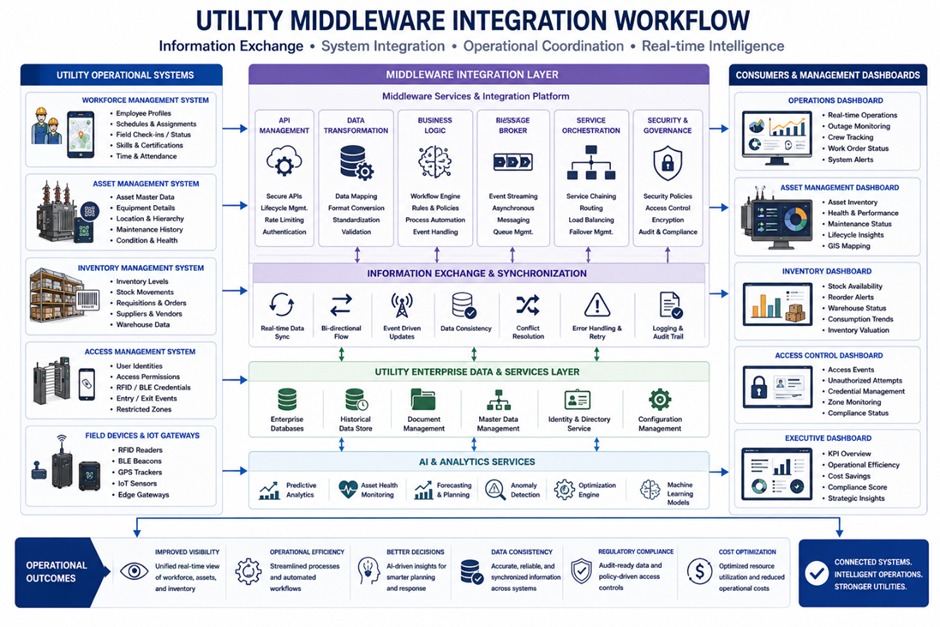
Utility Middleware Integration Workflow Diagram for AI Analytics, Enterprise Systems, and Operational Data Synchronization
This workflow diagram shows how middleware services synchronize data between workforce management, asset management, inventory, access control, utility databases, AI analytics devices, and executive dashboards. It demonstrates real-time information exchange, centralized integration, and operational coordination that improve data consistency, decision-making, compliance reporting, and enterprise-wide utility performance.
SCADA & DERMS Interoperability
Grid operators often rely on SCADA and Distributed Energy Resource Management Systems (DERMS) to support operational activities.
SCADA Connectivity
SCADA environments provide operational visibility into power system activities. Integration supports:
SCADA interoperability helps align operational activities with field execution.
DERMS Connectivity
Renewable energy resources and distributed energy assets continue to expand across utility environments. DERMS integration helps organizations coordinate:
Connected information supports improved decision-making across distributed energy environments.
Operational Information Alignment
Integration between AIoT systems and utility operational environments helps ensure:
Alignment reduces information fragmentation across utility departments.
Edge Deployment for Grid Operations
Utility environments often require localized processing capabilities to support operational continuity and performance.
Edge Processing for Substation Sites
Substations frequently operate in environments where local processing provides operational advantages. Edge deployments support:
- Local information processing
- Reduced communication dependency
- Improved responsiveness
- Operational continuity
- Local workforce visibility
Edge processing helps maintain operational functionality even when communication paths are limited.
Utility Facility Edge Operations
Utility facilities can use edge processing to support:
- Asset identification
- Workforce visibility
- Access management
- Inventory operations
- Local reporting
These capabilities improve operational resilience by supporting reliable workflows, faster responses, better coordination, and effective resource management.
Distributed Utility Infrastructure Support
Utilities often operate infrastructure across wide geographic areas. Edge processing enables:
- Localized operations
- Regional information management
- Site-level visibility
- Operational continuity
Distributed deployments support the needs of geographically dispersed utility networks while improving system reliability, accessibility, and operational flexibility.
Field Edge Synchronization
Field operations require information consistency between mobile activities and central management systems.
Workforce Synchronization
Synchronization helps maintain consistency across:
Asset Synchronization
Asset information synchronization supports:
Operational Record Consistency
Maintaining consistent records helps utilities:
Cloud Grid Management Software
Cloud deployments provide centralized visibility across utility operations.
Enterprise Visibility
Cloud environments support multi-site operations, centralized reporting, workforce visibility, asset accountability, and inventory management. Organizations gain visibility across service territories and operational regions.
Scalability for Utility Growth
Cloud environments support expanding asset populations, additional workforce resources, new utility facilities, renewable energy operations, and infrastructure modernization programs.
Remote Operational Access
Authorized personnel can access operational information from approved locations, improving coordination and decision-making.
Server-Based Grid Deployment
Many utility organizations maintain dedicated infrastructure environments for operational systems.
Utility-Controlled Environments
Server deployments support internal infrastructure requirements, utility security policies, regulatory obligations, and operational governance.
Dedicated Operational Resources
Organizations may prefer server deployments when requiring controlled access, internal administration, dedicated computing resources, and utility-managed environments.
Security and Compliance Alignment
Server deployments can help support utility-specific security and compliance objectives while providing greater control over data, access, infrastructure, and system management.
Integration Benefits for Utility Organizations
Effective integration helps utilities achieve:
Industry Experience Supporting Integration Projects
GridEnergy AI draws upon decades of practical IoT implementation experience developed through thousands of successful deployments across industrial and infrastructure environments. Supported by Aperture Venture Studio and GAO, the organization combines utility knowledge, integration expertise, and operational experience gained through projects supporting large enterprises, government organizations, research institutions, and critical infrastructure operators.
Technical teams include experienced engineers, software specialists, utility professionals, and Ph.D. experts who understand the complexities of integrating operational technologies, workforce systems, asset management applications, and utility software environments.
Next Steps
Integration is a critical component of successful AI and IoT deployments within smart grid operations. Connected systems help utilities improve workforce coordination, asset visibility, inventory management, access control, maintenance planning, and operational reporting.
GridEnergy AI helps utility organizations integrate workforce visibility systems, asset tracking solutions, inventory software, access management tools, SCADA environments, DERMS software, cloud deployments, and edge processing capabilities to support modern grid operations and long-term infrastructure performance.
Contact GridEnergy AI
Discuss your operational requirements with our technical specialists and explore how AIoT solutions can improve grid asset visibility, workforce safety, access control, inventory management, and utility infrastructure performance.
Contact Us